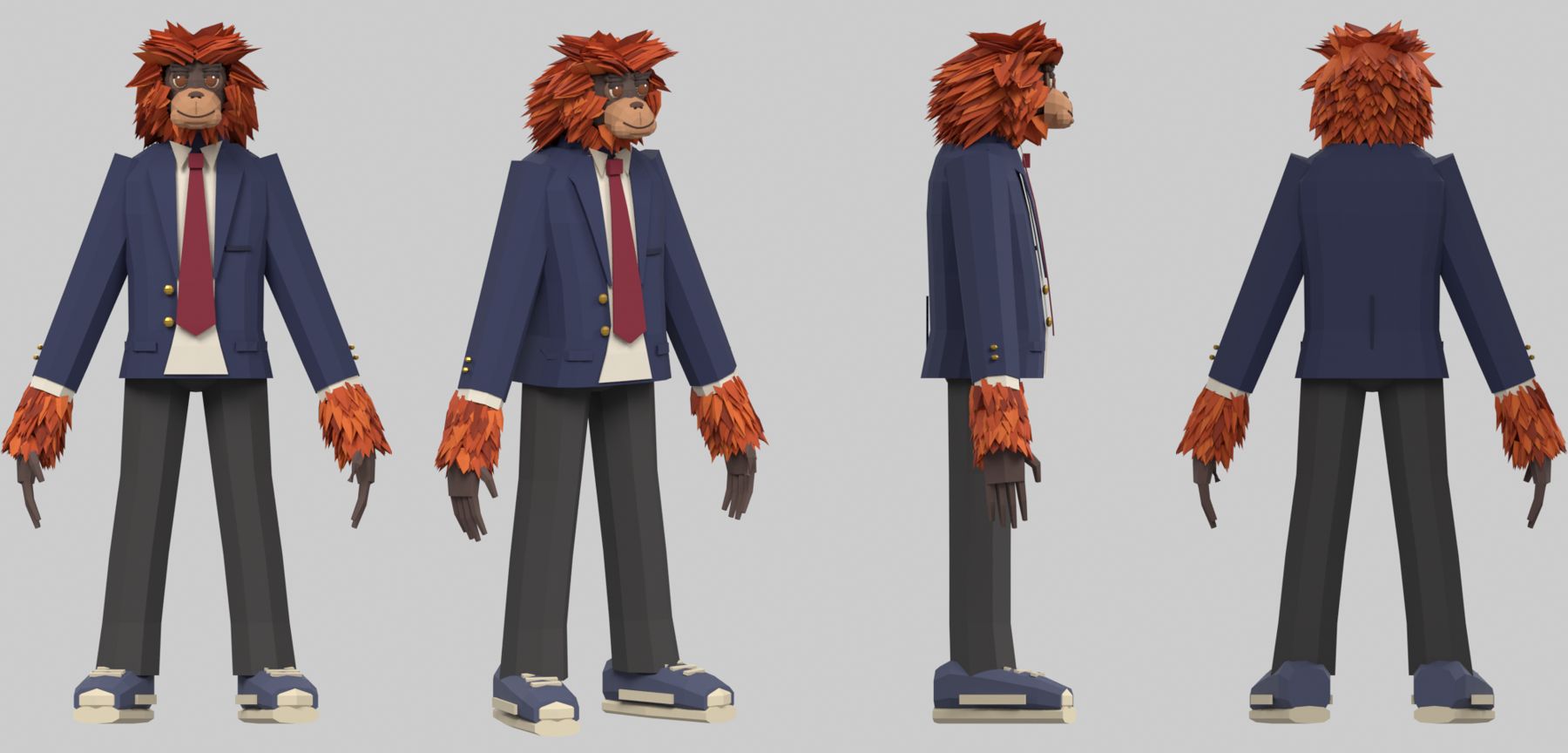
Puck Pullowski is an orangutan with a temper, a questionable sense of judgment, and a world that seems determined to make both worse. Set in the satirical world of Senile-ville, Puck the Hothead is an original game project exploring character design, physical comedy, movement, and a deliberately low-fidelity visual language inspired by the PS1 and early-2000s era. I'm currently developing the character and interaction language in Blender and Unity, from Puck's silhouette and personality to a rail-based traversal system built around grinding and momentum.
An original game: an orangutan with a temper, in a satirical PS1-style world.
Character, world and systems design; the model is rigged and in Unity.
In development: movement and rail-grinding are the next milestone.
Puck Pullowski is a "lazy genius": sharp-minded, easily provoked, and constitutionally allergic to doing things the hard way. The species isn't incidental. An orangutan's build, its long reach, its heavy-lidded stare, its capacity for both stillness and sudden violence, gives the character a silhouette and a temperament that a generic human protagonist wouldn't.
How do you make an orangutan feel like a playable character rather than a mascot? The answer so far has been restraint: keeping his design grounded and slightly menacing rather than cartoonish, so the comedy comes from what he does, not from how he looks.
Puck's world is Senile-ville, a satirical, slightly broken-down place with its own internal logic and its own legendary figure, Bjorn the Brave, whose myth looms over everything Puck does. The tone is closer to a skate-zine than a fantasy epic: dusk purple, hothead orange, mustard yellow, all filtered through a deliberately low-fidelity PS1-era visual language.
The PS1/early-2000s aesthetic isn't nostalgia for its own sake. It sets a hard constraint (low polygon counts, harsh lighting, limited texture detail) that forces every design decision, from Puck's silhouette to the environment, to communicate with less.
Puck's design moved through real stages: rough character sketches and head studies, a full page of pose studies exploring how he holds himself, a locked silhouette, then a Blender model built to match it, and finally rigging and import into Unity.
The silhouette needed to remain readable at low resolution and exaggerated enough to survive the PS1-inspired visual language. That single constraint drove most of the early pose and proportion work before a single polygon was modeled.
I wanted traversal to feel less like navigating a map and more like being thrown through it. That's the reasoning behind building movement around rail-grinding rather than conventional platforming: momentum becomes the primary feeling, not an incidental one.
Grinding exists because Puck's personality, impatient, a little reckless, shouldn't just show up in dialogue. It should show up in how he moves. That's the design bet this section of the project is actually testing.
This project is still in development, so instead of claiming results that don't exist yet, here are the actual design questions currently being worked through:
How do you make an orangutan feel like a playable character rather than a mascot?
How can movement communicate Puck's personality, not just his dialogue?
Can grinding become a form of expression rather than simply transportation?
How far can a PS1-era visual language be pushed while keeping gameplay readable?
Puck's silhouette, personality, and pose language are locked. The Blender model and Unity import are underway, alongside early experiments with the grind-based traversal system. Nothing here claims to be a finished game. It's a real project at a real, honestly stated stage.
Next: environment blockout, a working traversal prototype, a playable loop, then real playtesting. Once that loop exists and has been tested, this page upgrades from a development journal into a full case study.